实现电池反接保护的电路, Circuit Provides Reverse-Battery Protection
 加入技术交流群
实现电池反接保护的电路, Circuit Provides Reverse-Battery Protection
A universal problem in battery-operated devices is the threat of damage when an end user (never an engineer) inserts the battery backward. You can avoid damage by inserting a single diode or by using a diode-bridge configuration, but those fixes waste power and reduce the supply voltage by adding one or two diode drops between the battery and the supply rail. An alternative solution not only protects against battery-reversal damage but also automatically corrects the reversal (see the figure below). To eliminate the voltage drops associated with discrete diodes, a low-on-resistance, DPDT (double-pole/double-throw) switch serves as a full-wave rectifier. When you insert the battery with the correct polarity as shown, the upper switch, S1, is in its normally closed state, because its control pin is in its low state. The resulting connection from pin 2 to pin 10 provides a low-impedance path from the battery to the VCC terminal. Conversely, the lower switch, S2, closes its normally open terminal (not as shown), because its control pin is in its high state. The resulting path from pin 7 to pin 6 connects the battery's negative terminal to ground.
The ESD-protection diodes in IC1 guarantee startup and act as a full-wave rectifier. MOSFETs internal to the analog switch turn on when the battery voltage exceeds 1V. Their less-than-20-nsec turn-on time enables the circuit to maintain normal operation by quickly swapping the leads of a reversed-polarity battery connection. The circuit resistance depends on the battery voltage. When the circuit operates from four NiCd, NiMH, or alkaline cells, the resistance in each leg of the rectifier is 2.5Ω (5Ω total). Operation with a two-cell battery (2.4V to 3V) yields a total resistance of 10Ω. IC1 is rated for operation to 5.5V with 30-mA continuous current, making the circuit useful for cordless phones, portable audio equipment, hand-held electronics, and other light- to medium-current applications. IC1's miniature 10-pin µMAX package takes less space than four through-hole signal diodes and is almost as small as two SOT-23 dual signal diodes.
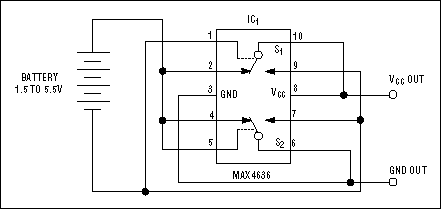
Figure 1. This circuit senses battery polarity and then quickly connects the load or swaps the battery leads.
专栏文章内容及配图由作者撰写发布,仅供工程师学习之用,如有侵权或者其他违规问题,请联系本站处理。 联系我们
相关推荐
单片机自动报时控制器
美国或将再立AI GAIN法案,要求本国AI芯片制造商向海外供货前先满足国内需求
MAX1678构成的适用于寻呼机的高效率单电池升压电源
电源产品的可靠性设计(中)
BAE公司开发\"秃鹫\"II一体化传感器技术
阿里云领投机器人初创公司,首次布局具身智能
单片机自动报时控制器s
图腾柱电路构成与工作图示
单片机在实验中的应用
MAX761构成的可调输出升压电源
时尚的光芒难掩技术上的尴尬 国产手机痛失彩信市场
“一芯四用”,米尔RK3576如何同时驾驭4路YOLOv8视频流?
最新全球半导体设备市场报告:中国大陆以约34.4%的份额稳居第一
单片机在语音存储与回放中的应用
大连建世界最大的发光产业基地
电源产品的可靠性设计(下)
2位会员申请认证
力科示波器助力电源研发(上)
近200场演讲,300+展商,2万平展览!ICCAD-Expo 2025 议程公布!
单片机在路灯定时控制系统中的应用
台积电计划从明年开始对先进制程晶圆价格提高5%-10%
基于新技术电源控制IC的绿色高效 高功率密度电源的设计
半导体IP市场有所增长,MIPS公司排名急剧下跌
精细认识电路电流回路是关键
用TL499A构成的升压型稳压电源和电池后备电源
国产厂商切入下一代存储技术:3D DRAM
用MAX632组成的高效升压稳压电源
力科示波器助力电源研发(下)
用MC34063制作的降压变换电源
贸泽开售适用于高性能网络和工业物联网应用的Microchip Technology MCP16701 PMIC